
Blog Posts
Signs of Meth Addiction You Should Notice
Apr
A person rarely says, out loud and early, that meth has started running the show. What usually shows up first are patterns – long stretches without sleep, sudden weight loss, skin picking, paranoia, fast talking, money disappearing, and relationships getting tense for reasons that do not add up. The signs of meth addiction can build fast, but they can also hide in plain sight when people explain them away as stress, burnout, or a rough patch.
If you are trying to figure out whether meth use has crossed into dependence, the real question is not whether someone has used once or twice. It is whether the drug is starting to shape their body, mood, judgment, priorities, and daily routine. That shift matters because meth addiction tends to escalate the longer it goes unaddressed.
What meth addiction often looks like early on
Early meth use does not always fit the stereotype people expect. Some people seem unusually productive at first. They may stay awake for long periods, talk more, show intense confidence, or act hyper-focused. That can fool friends, partners, or even the person using into thinking the drug is helping.
But the early signs usually come with instability. Energy spikes turn into crashes. Appetite drops off. Sleep becomes irregular or disappears for a day or two at a time. A person may become more irritable, secretive, or reactive, especially when questioned about where they have been, how long they have been awake, or why they are acting differently.
This is where context matters. One sign on its own does not prove addiction. Several changes happening together, especially around sleep, mood, appearance, and money, are much harder to ignore.
Common signs of meth addiction
The clearest signs of meth addiction usually show up across three areas at once – physical health, behavior, and mental state. Meth is a stimulant, so a lot of the warning signs come from prolonged overstimulation followed by sharp crashes.
Physical changes
One of the biggest red flags is rapid weight loss. Meth often suppresses appetite so heavily that people eat very little for long stretches. At the same time, sleep deprivation and dehydration can make someone look run down fast. Their face may seem more drawn, their skin duller, and their overall appearance less healthy than it did just weeks earlier.
Skin problems are also common. Repetitive scratching or picking can leave sores, scabs, or marks that do not heal well. Dental decline can develop over time too, especially when dry mouth, poor hygiene, grinding, and nutrition problems pile up together.
You may also notice enlarged pupils, excessive sweating, jaw clenching, restlessness, or repetitive body movements. None of these signs are exclusive to meth, but in combination they can be very telling.
Behavioral changes
Behavior often shifts before a person admits anything is wrong. Meth addiction tends to reorganize priorities. Someone who used to be reliable may start disappearing, breaking plans, missing work, or showing up late with weak explanations. Money can start vanishing quickly, either because more of the drug is being used or because judgment is getting worse.
Secrecy is another common sign. People may guard their phone, avoid direct questions, isolate from family, or rotate between intense social activity and complete withdrawal. Some become unusually driven and talkative while high, then unreachable or emotionally flat during the comedown.
Risk-taking can increase too. That may mean reckless driving, unsafe sex, aggressive confrontations, staying in unstable environments, or making decisions that they would not normally make. Meth lowers inhibition while inflating confidence, and that mix can get dangerous fast.
Mental and emotional signs
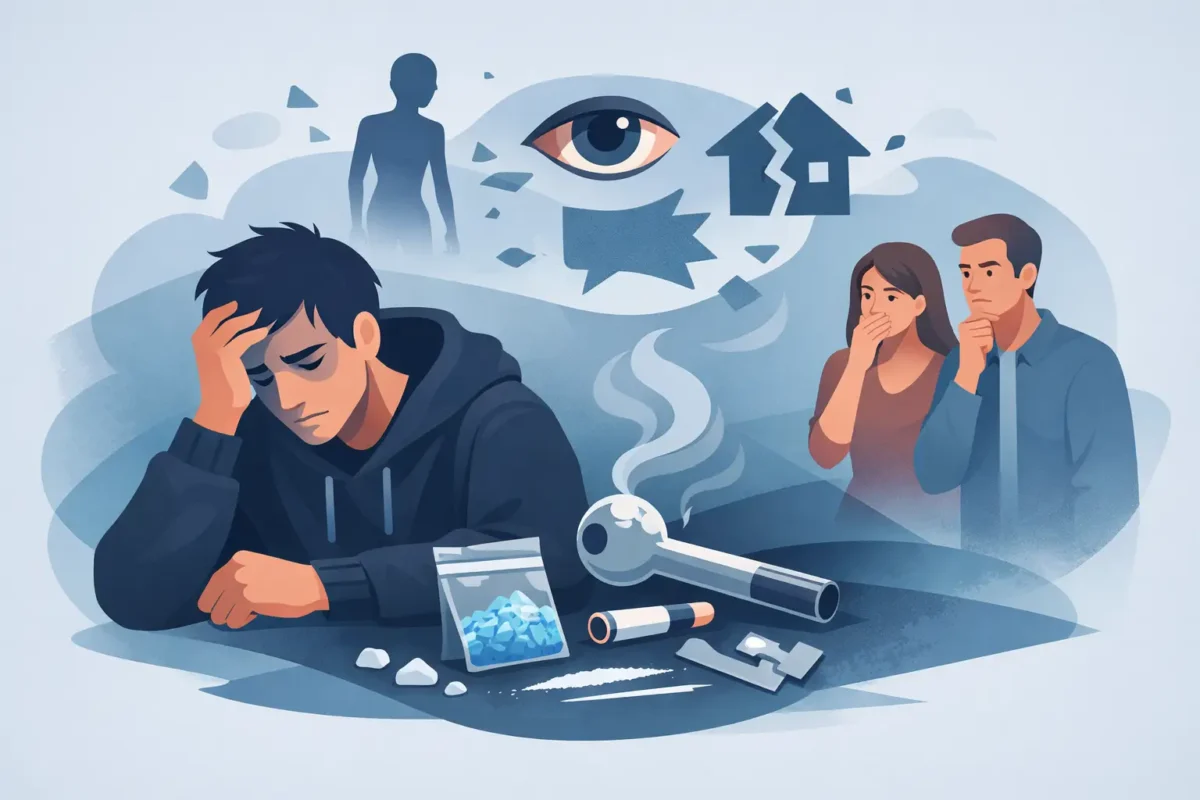
Meth addiction often affects the mind in ways that are hard for other people to manage. Irritability is common. So are mood swings, anxiety, agitation, and sudden defensiveness. A person may seem suspicious for no clear reason, misread other people’s intentions, or react as if they are being watched, judged, or threatened.
With heavier or prolonged use, paranoia can become severe. Some people hear or see things that are not there. Others become fixated on certain ideas and cannot be talked out of them. This is one of the biggest signs that meth use has moved beyond casual experimentation into something more destabilizing.
When use becomes addiction
The line between frequent use and addiction is not always obvious from the outside. A person can insist they are in control while their life starts narrowing around access, recovery, and repeat use. That is why it helps to look at function instead of excuses.
If someone keeps using despite obvious harm, that points to addiction. If they cannot stop for long, need more to get the same effect, or spend large parts of their time using, recovering, or chasing the next run, the problem is usually deeper than occasional drug use. Cravings matter too. When the urge becomes hard to resist, even after serious consequences, dependence is often in play.
Another clue is the crash cycle. Meth can produce periods of intense wakefulness followed by exhaustion, depression, and heavy sleep. People caught in addiction often use again not just to get high, but to avoid the crash, the emptiness, or the mental fog that follows.
Signs of meth addiction in day-to-day life
In real life, addiction rarely appears as one dramatic moment. It tends to leak into ordinary routines. The kitchen has no groceries. Rent is suddenly late. Messages go unanswered for long stretches. Personal hygiene drops. Work performance slips. Family members stop trusting what they are being told.
At home, the environment may become chaotic. Sleep schedules are upside down. There may be bursts of cleaning or obsessive activity followed by total burnout. Some people become intensely focused on small tasks for hours. Others become emotionally volatile and hard to predict.
In relationships, meth addiction often creates a cycle of promises, conflict, and denial. A person may apologize, swear they are done, then disappear again or return to the same behavior within days. That does not mean they do not care. It often means the drug has started overriding the parts of life they once valued most.
Why meth addiction is easy to miss at first
Meth can be misleading because its short-term effects can look functional before the damage becomes obvious. Someone may seem more awake, more social, more motivated, or more confident. In certain circles, that can even get mistaken for improvement.
The trade-off is that the boost does not stay clean for long. Sleep loss alone can wreck judgment, patience, and emotional stability. Add poor nutrition, repeated binges, and psychological strain, and the decline can happen quickly. People around the user sometimes keep waiting for clearer proof while the problem gets harder to reverse.
That is why timing matters. You do not need to wait for total collapse to take warning signs seriously.
What to do if you notice these signs
If you think someone is showing signs of meth addiction, pushing too hard too fast can backfire. Accusations often trigger denial, anger, or disappearance. A calmer approach works better. Speak plainly about what you have seen – the sleep loss, the weight change, the mood swings, the paranoia, the missed responsibilities. Stick to patterns, not insults.
It also helps to think about safety first. If a person is hallucinating, extremely paranoid, aggressive, or has not slept for days, this can move beyond a conversation and into a medical or psychiatric emergency. In those cases, immediate professional help matters more than winning the argument.
If the person is open to help, treatment options can include detox support, behavioral therapy, outpatient care, inpatient rehab, and ongoing recovery planning. What works best depends on severity, mental health, housing stability, and whether the person actually wants to stop. There is no single route that fits everyone.
For family or partners, boundaries are part of help too. Covering every consequence can keep the cycle going. Support does not have to mean financing the damage or pretending not to see it.
The hardest part is usually admitting the pattern
A lot of people recognize meth addiction only after the signs stop being subtle. By then, trust may be damaged, health may be worse, and the person using may feel trapped between craving and crash. Still, earlier recognition gives you more room to act before the situation gets even more dangerous.
If the signs are stacking up, do not wait for a perfect label. Pay attention to the pattern, trust what repeated changes are telling you, and treat the situation with the urgency it deserves.